



Acid Tanker Transportation in India : Safety & Logistics Guide
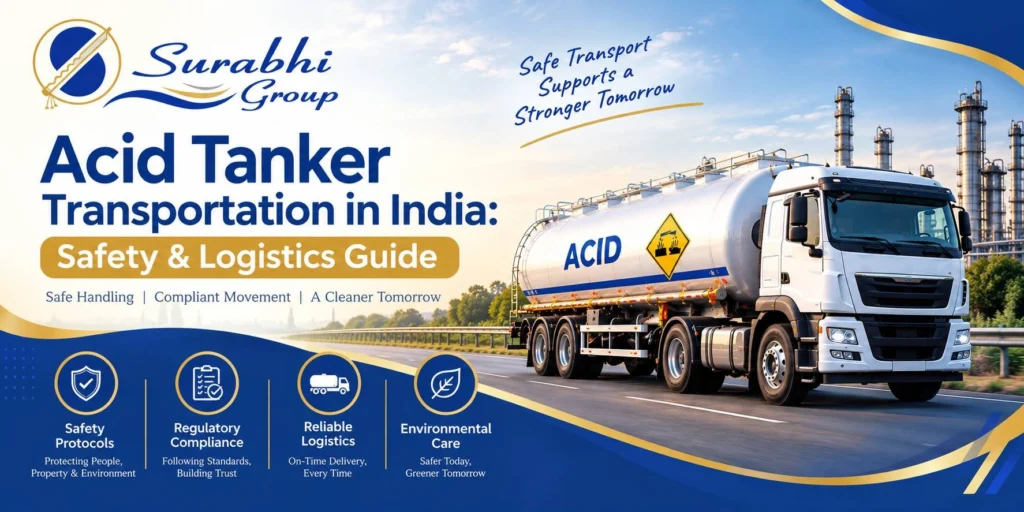
Corrosive acids don’t forgive mistakes. A cracked lining, an overfilled tank, or an untrained handler can turn a routine delivery into a serious safety incident — which is why acid tanker transportation in India is treated as one of the most demanding categories of hazardous chemical logistics.
At Surabhi Group, we’ve built our operations around exactly this challenge — moving industrial acids safely across India’s manufacturing and chemical hubs without compromising on compliance or handling standards. In this guide, we’re breaking down what real, dependable acid transportation in India actually looks like — the risks, the regulations, and the practical steps that separate a safe transporter from a risky one.
What Is Acid Tanker Transportation ?
Acid tanker transportation is the specialized process of moving corrosive liquid acids — such as sulphuric, hydrochloric, or nitric acid — by road using tankers built with acid-resistant linings, pressure controls, and leak-prevention systems. Because these chemicals corrode standard metals and pose serious health hazards on contact or inhalation, transport requires purpose-built vehicles, certified drivers, and strict regulatory compliance at every stage.
Acids are core inputs across India’s fertilizer, textile, pharmaceutical, and metal processing industries. But their corrosive and reactive nature means a single lapse in handling — during loading, transit, or unloading — can lead to equipment damage, environmental contamination, or injury.
Why Acid Transport Requires Specialized Handling ?
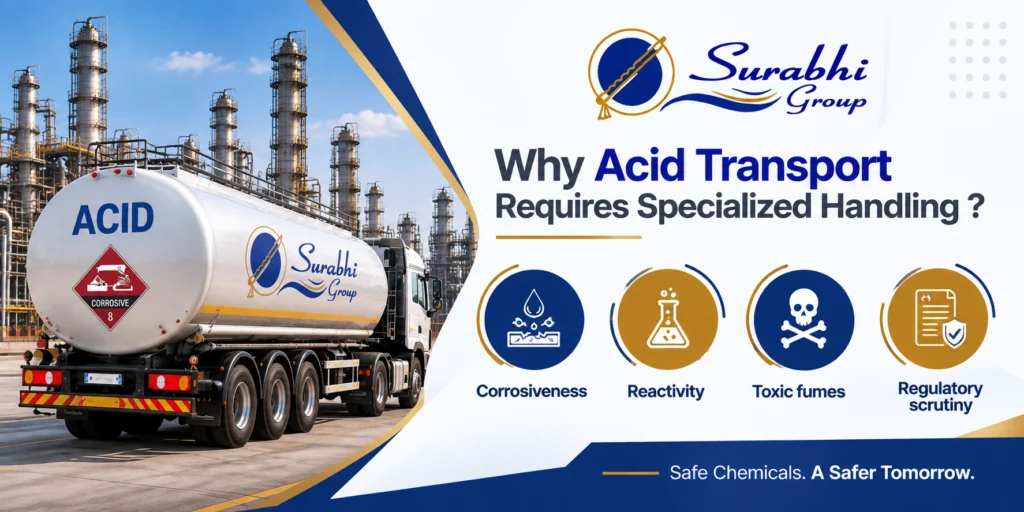
Acid isn’t cargo you can move with a standard tanker fleet. Here’s what makes it uniquely demanding :
- Corrosiveness — Requires tankers lined with acid-resistant materials like rubber, PTFE, or specialized alloys
- Reactivity — Certain acids react violently with water, metals, or other chemicals if mixed accidentally
- Toxic fumes — Leaks can release harmful vapors that affect drivers and nearby communities
- Regulatory scrutiny — Falls under PESO norms, the Motor Vehicles Act’s hazardous goods rules, and Central Motor Vehicle Rules (CMVR) for tank vehicles
This is exactly why generic transporters fall short here — and why industries increasingly seek out partners with genuine hazardous acid transportation experience.
The Real Risks of Acid Transportation in India
India’s chemical corridors have seen their share of acid transport incidents — tanker corrosion leading to leaks, spillage during loading at congested industrial sites, and accidents on highways where acid cargo reacted with surrounding materials. These aren’t isolated events; they’re evidence of what happens when safety protocols are treated as a formality rather than a discipline.
Common risk points include :
- Tanker linings degrading unnoticed due to skipped inspection cycles
- Overloading or incorrect acid-to-tanker compatibility
- Drivers untrained in acid-specific emergency response
- Poor route planning through congested or residential zones
- Missing or expired safety documentation during transit checks
Recognizing these risks is step one. Managing them with a systematic process is what actually prevents incidents.
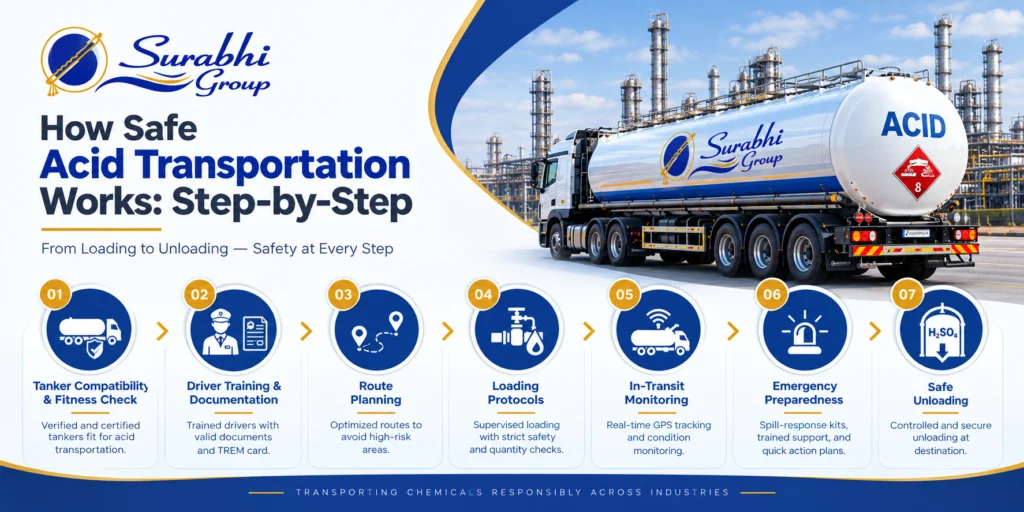
How Safe Acid Transportation Works: Step-by-Step ?
Step 1: Tanker Compatibility & Fitness Check
Every tanker is matched to the specific acid type being transported, with linings and valves inspected for corrosion, wear, and pressure integrity before dispatch.
Step 2: Driver Training & Documentation
Drivers undergo hazardous material handling training and carry a Transport Emergency (TREM) card detailing exact steps for spills, exposure, or accidents involving that specific acid.
Step 3: Route Planning
Routes are mapped to minimize exposure risk near populated areas, with pre-identified emergency stop points and coordination with local authorities where required.
Step 4: Loading Protocols
Loading is supervised with strict quantity and compatibility checks to prevent overfilling or cross-contamination with incompatible substances.
Step 5: In-Transit Monitoring
Tankers are increasingly fitted with GPS tracking and leak-detection sensors to flag anomalies in real time during transit.
Step 6: Emergency Preparedness
Every tanker carries neutralizing agents, protective gear, spill-containment kits, and direct contact numbers for local disaster management teams.
Step 7: Safe Unloading
Unloading follows the same disciplined protocol as loading — controlled release, trained personnel, and cross-verification against dispatch documentation.
Regulatory Compliance: What the Law Requires
- What licenses are required for acid transportation in India?
Acid transporters need a valid PESO license where applicable, hazardous goods transport permits under the Motor Vehicles Act, a Transport Emergency (TREM) card for the specific acid being carried, and compliance with Central Motor Vehicle Rules for tank vehicle construction.
Key compliance areas include :
| Requirement | Purpose |
|---|---|
| PESO / Hazmat Permit | Certifies tanker is authorized for corrosive chemical transport |
| TREM Card | Provides emergency response instructions specific to the acid being carried |
| CMVR Tank Vehicle Norms | Governs construction and material standards for acid tankers |
| Driver HAZMAT Training | Ensures drivers can respond correctly to leaks, spills, or exposure |
| Route Approval | Confirms transport path minimizes risk in populated or sensitive zones |
Non-compliance doesn’t just risk safety — it can trigger shipment delays, regulatory penalties, and reputational damage for the businesses depending on that transport.
Benefits of Partnering With an Experienced Acid Transporter
Choosing the right partner for liquid acid transportation affects far more than delivery timelines — it shapes your safety record, compliance standing, and operational continuity.
- Reduced risk exposure through acid-compatible tankers and trained personnel
- Fewer delivery delays from proactive maintenance and route planning
- Regulatory peace of mind with documentation handled correctly every time
- Emergency readiness that protects cargo, drivers, and surrounding communities
- Consistent service across multiple industrial hubs and acid types
Acid Tanker Transport Across India's Key Industrial Hubs
Acid demand is concentrated around India’s major chemical, fertilizer, and manufacturing belts — and route familiarity in these zones is critical for safe, on-time delivery.
We provide acid tanker transport services across major industrial and port cities including Mumbai, Bharuch, Hazira, Dahej, Kandla, Jamnagar, Baroda, Kochi, Mangalore, and Chennai — corridors that handle some of the heaviest bulk acid movement in the country due to concentrated chemical and processing operations.
Each of these regions comes with its own traffic patterns, industrial access protocols, and local regulatory checkpoints — which is why route-specific experience matters just as much as the tanker itself.
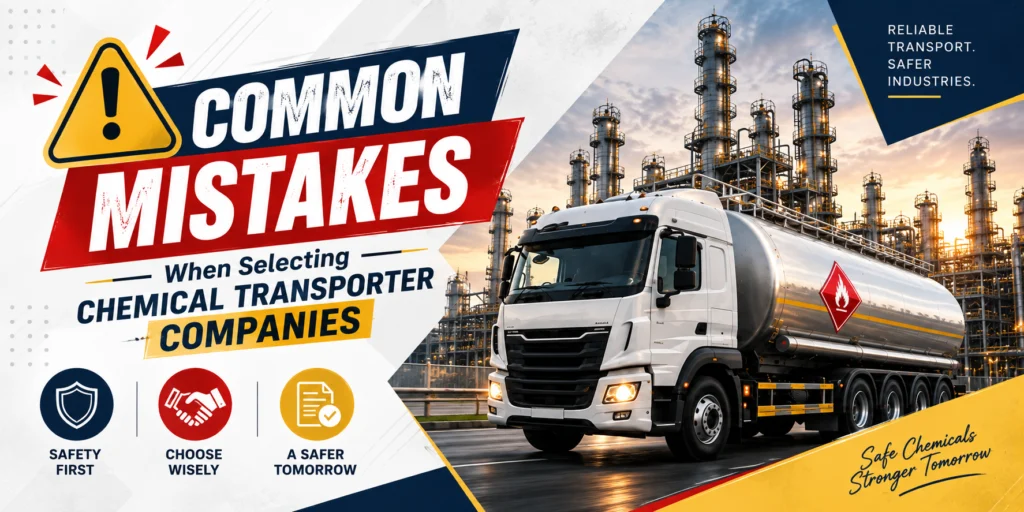
Common Mistakes Businesses Make When Choosing Acid Transporters
Based on what we’ve seen across the industry, these mistakes come up repeatedly :
- Selecting transporters purely on lowest quote without checking tanker-acid compatibility
- Assuming all corrosion-resistant tankers work for every acid type
- Skipping verification of driver HAZMAT training records
- Not confirming emergency response protocols before dispatch
- Overlooking route-specific experience in congested industrial corridors
Avoiding these mistakes upfront saves far more in avoided delays, penalties, and safety incidents than any short-term cost savings.
Industry Insight: Why Compatibility Matters More Than Fleet Size
A large fleet means little if the tankers aren’t correctly lined and maintained for the specific acid being moved. In our experience, the transporters who perform best over time are the ones who treat tanker-acid compatibility as non-negotiable on every single trip — not just the high-volume ones. Precision, not scale, is what actually prevents corrosion failures and leaks.
Acid tanker transportation is the process of moving corrosive liquid acids by road using specialized, acid-resistant tankers built to handle their corrosive and reactive properties safely, under strict regulatory compliance.
Yes. Acid transportation in India is regulated under PESO norms where applicable, Central Motor Vehicle Rules for tank vehicles, and requires drivers to carry a Transport Emergency (TREM) card specific to the acid being transported.
Safety measures include acid-compatible, corrosion-resistant tankers, trained HAZMAT drivers, pre-planned routes avoiding populated zones, onboard spill-containment kits, and real-time leak-detection monitoring during transit.
Costs vary based on distance, acid type, quantity, and regulatory documentation needs. Getting a tailored quote from a certified transporter is the most accurate way to estimate costs for your specific requirement.
We provide acid tanker transport services across Mumbai, Bharuch, Hazira, Dahej, Kandla, Jamnagar, Baroda, Kochi, Mangalore, and Chennai — covering major industrial and chemical processing hubs.
Verify tanker-acid compatibility, driver HAZMAT training records, tanker maintenance and lining inspection history, emergency response protocols, and experience with your specific transport route before finalizing a partner.